

What villages have been systematically denied
Across India and much of the developing world, villages have never lacked potential. What they have lacked is access. Quality education, modern healthcare, reliable infrastructure, advanced technology exposure, organised employment ecosystems, and well-planned public spaces have historically remained concentrated in cities.
This imbalance forced a single outcome. Migration. Villages became suppliers of people, while cities became collectors of opportunity. Over time, this weakened rural economies, strained urban systems, and created a false belief that progress only exists within city boundaries.
The issue was never geography. It was design.
Introducing Sustainable Smart Green Villages
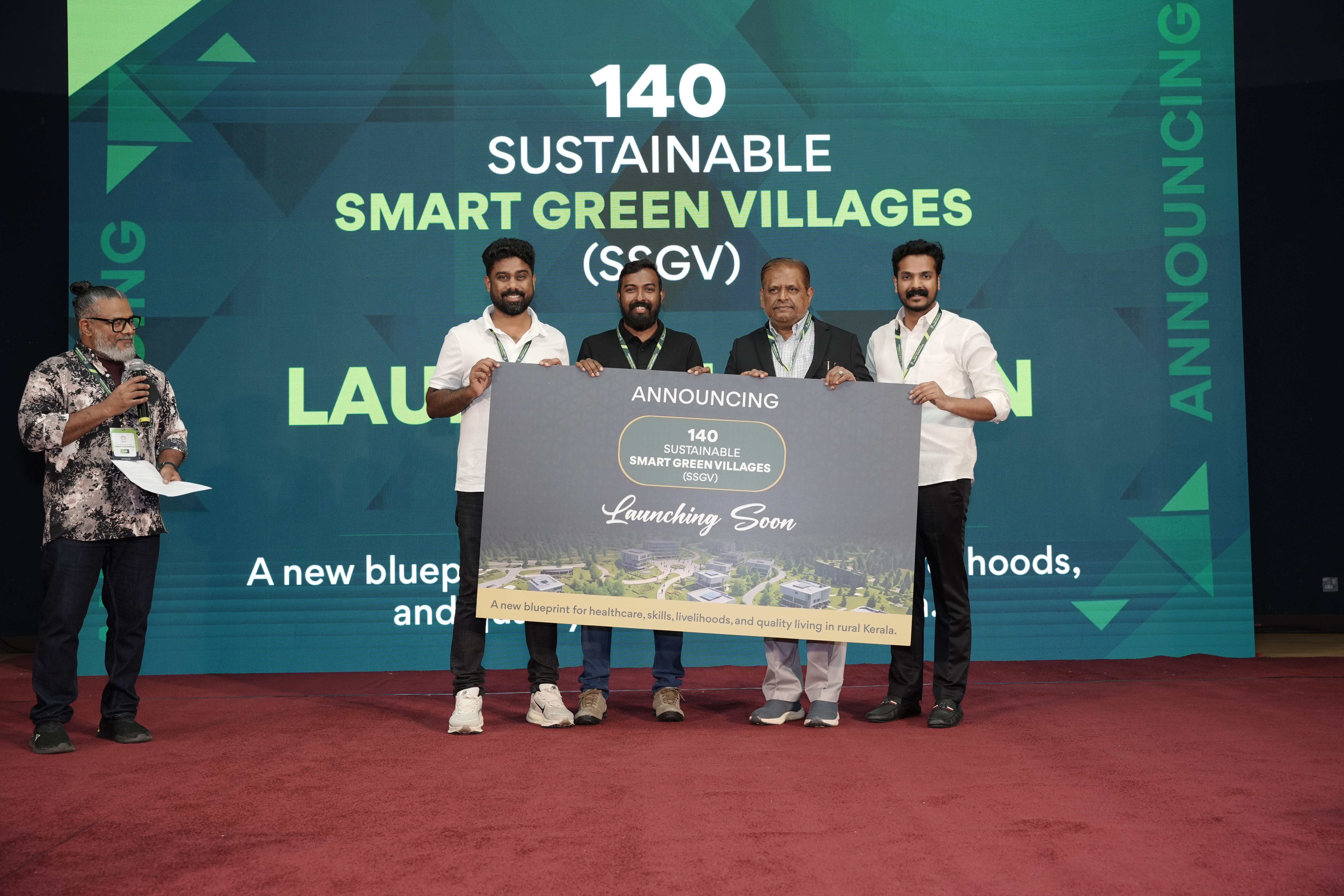
Sustainable Smart Green Villages, known as SSGV, is a structured attempt to correct this design failure. The project reimagines villages as complete, future-ready ecosystems equipped with urban-grade infrastructure while remaining environmentally responsible and socially grounded.
SSGV is not about converting villages into cities. It is about delivering the benefits of urban living without importing urban dysfunction. Every element, from housing to education and from mobility to energy, is planned as part of one integrated system.
This is development engineered for longevity, not speed.
Where the SSGV vision is being implemented
The Sustainable Smart Green Villages initiative is planned across all 140 Assembly constituencies of Kerala, covering approximately 1,400 acres in total. Each SSGV spans around 10 acres and follows a common foundational framework while retaining a distinct identity shaped by its location.
World-class facilities built into village life
Every Sustainable Smart Green Village is designed with a shared set of core facilities. These include planned residential infrastructure, utility systems, internal mobility, digital connectivity, green spaces, and essential civic amenities. This common baseline ensures consistency in quality of living, infrastructure reliability, and long-term sustainability across all locations.
What differentiates each SSGV is a single, clearly defined attraction aligned with the character and potential of the location. Instead of repeating identical developments, Talrop has structured the project so that every village contributes a distinct capability to the broader network.
This design creates a distributed development system rather than isolated growth pockets. Each village strengthens the whole, forming an interconnected ecosystem rather than competing developments.
The first SSGV implementation begins at Pangode in Thiruvananthapuram
The first implementation of this vision is planned in Pangode village, Thiruvananthapuram district. Here, the distinct attraction is an International Technology Campus developed by Steyp, a venture from Talrop. Designed as a global-facing education and innovation ecosystem, the campus integrates advanced learning infrastructure within the village framework.
Positioned inside the SSGV model, the International Technology Campus demonstrates how world-class technology education, modern infrastructure, and village life can coexist without compromise.
Sustainability as a non-negotiable foundation
Environmental responsibility is not positioned as an add-on within SSGV. It is the foundation. Each village is designed to operate with minimal carbon footprint through renewable energy adoption, efficient water reuse systems, sustainable waste management, and extensive green cover.
Low-emission transport planning, solar-powered infrastructure, and climate-sensitive architecture reduce dependency on fossil fuels. Green spaces are not decorative. They are functional components of health, energy efficiency, and long-term resilience.
The objective is clear. Growth without carbon-heavy compromise.
How the world will view Kerala after SSGV
When villages begin offering the same quality of infrastructure, education, and opportunity as cities, global perception shifts. Kerala moves from being seen only as a socially progressive state to being recognised as a scalable development model.
International students choosing village-based technology campuses, professionals building careers outside congested cities without sacrificing quality of life, enterprises operating from non-urban hubs, and communities growing without ecological degradation send a powerful signal. It shows that global relevance no longer depends on urban density, that talent no longer needs metropolitan dependence, and that development can scale without exhausting land, people, or resources.
It demonstrates that world-class development does not require urban excess. It requires intelligent planning.
A reference model for balanced growth
Sustainable Smart Green Villages is not positioned as a regional experiment. It is a replicable framework for any geography seeking balanced growth. By integrating land, infrastructure, education, technology, and sustainability into a single system, SSGV challenges outdated assumptions about where progress must live.
Led by Talrop, the project represents a shift from fragmented development to coherent design thinking.
This initiative marks a shift in how villages function and how progress is defined.